Summary:
Office refurbishments don’t always mean closing your business or moving your entire team elsewhere. With careful planning, phased installation and a programme that considers your working hours, many improvements can take place while your business continues operating. The key is identifying which activities need protecting, which areas can remain accessible and when more disruptive work should take place.
Your office might desperately need updating, but finding a convenient time to carry out the work is another matter entirely. After all, there are employees who need somewhere to work, customers expecting a service and deadlines that won’t disappear simply because you’ve decided to replace the flooring.
For many businesses, the disruption associated with an office refurbishment is enough to postpone it indefinitely. However, closing the entire workplace isn’t always necessary.
At SSC Interiors, we understand that your business needs to carry on while improvements are being made. By looking at how your premises operate before planning the work, it’s often possible to organise a refurbishment around your team rather than the other way around.

Can office refurbishments take place while your business is open?
Yes, many office refurbishment projects can be carried out while a business remains operational, although this depends on the scope of work, the building and the activities taking place inside it.
Replacing ceiling tiles, updating lighting, installing new partitions or redecorating an office may be possible without closing the whole building. However, these activities still need to be scheduled and managed appropriately, particularly when people are working nearby.
A small office with one entrance and a single working area will present different challenges from a larger building with several floors. Similarly, a business handling confidential telephone calls might need a different approach from an office where staff are regularly out visiting clients.
Before beginning any work, it’s important to understand which areas must remain available and whether the proposed improvements could interfere with essential activities.
Sometimes this means carrying out work in stages. In other situations, it might involve temporarily relocating a department, adjusting working arrangements or scheduling certain activities outside normal hours.
The aim isn’t necessarily to eliminate every inconvenience, which may not be realistic, but to identify potential disruption early and find sensible ways to manage it.
Planning office refurbishments around your working day
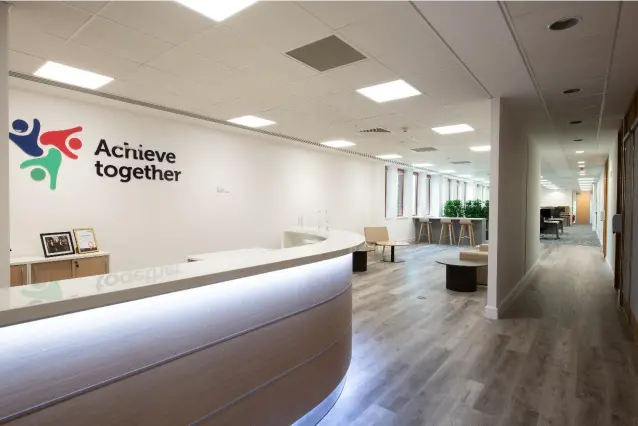
Every workplace operates differently, which is why effective office refurbishment planning begins with understanding the people using the building.
A meeting room that sits empty most afternoons might seem like an ideal place to begin. However, if it’s needed for a recurring client appointment every Tuesday morning, that information could make a considerable difference to the proposed schedule.
The same applies to entrances, communal areas and facilities that staff rely on throughout the day.
Identifying your business’s busiest periods
An early discussion about daily operations can reveal opportunities for scheduling work more conveniently.
For example, there may be days when fewer employees are on site, departments that regularly work remotely or periods when visitors are less likely to attend the premises.
It helps to establish:
– Which departments or areas must remain operational.
– When the building is busiest and quietest.
– Whether employees can temporarily use alternative working areas.
– Which meeting rooms, kitchens and toilet facilities need to remain available.
– Whether certain activities require uninterrupted access to power, data or other services.
These details help shape a programme that reflects the reality of running your business.
Deciding what can be temporarily relocated
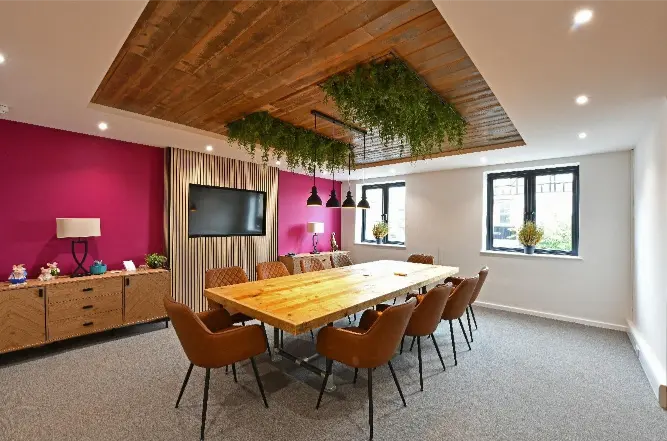
Not every refurbishment requires a complete office move. Sometimes, temporarily moving a small team to another part of the building creates enough space for a particular stage of work.
This might involve using an available meeting room as a temporary workspace or arranging remote working for a limited period.
However, temporary arrangements need to be suitable for the employees involved, including their equipment, accessibility requirements and ability to carry out their work.
At SSC Interiors, our approach begins with discussing your requirements and surveying the existing premises, so the proposed design and installation can be considered alongside the building’s practical constraints.

How phased office refurbishments can help minimise disruption
One of the most useful approaches to an occupied refurbishment is to divide the project into manageable stages.
Rather than removing ceilings, flooring and fittings across an entire workplace simultaneously, a phased office refurbishment can allow certain areas to be completed while others remain in use.
For example, imagine an office with three separate departments. Depending on the building layout and the planned work, it may be possible to refurbish one department’s space while the other two continue operating.
Once the first area is suitable for occupation again, the next stage can begin.
This approach can help maintain usable office space throughout the project, although it may also mean the overall programme takes longer than completing all the work in one uninterrupted period.
Scheduling disruptive tasks outside working hours
Not all refurbishment activities cause the same level of disruption.
Painting an unoccupied meeting room may be relatively straightforward, while drilling, replacing flooring or carrying out electrical work could interfere with employees working nearby.
Where appropriate and agreed, certain tasks might be scheduled for evenings, weekends, lunch breaks or periods when staff are working elsewhere.
This doesn’t mean every refurbishment needs an out-of-hours team. Instead, the programme should identify which tasks genuinely benefit from alternative scheduling.
The availability of contractors, building access, noise restrictions and the additional costs associated with different working arrangements also need consideration.
Coordinating different elements of the refurbishment
An office refurbishment often involves several connected activities. New partitions might affect lighting arrangements, while replacing flooring could require furniture to be moved and equipment temporarily disconnected.
Completing these tasks in the correct sequence is particularly important when only part of the building is available for work at any one time.
With our complete fit-out and refurbishment service, SSC Interiors can help coordinate the design and installation of the different elements involved in updating your commercial premises.
By considering how each stage affects the next, the project can be planned around both the installation requirements and the people who need to continue using the space.
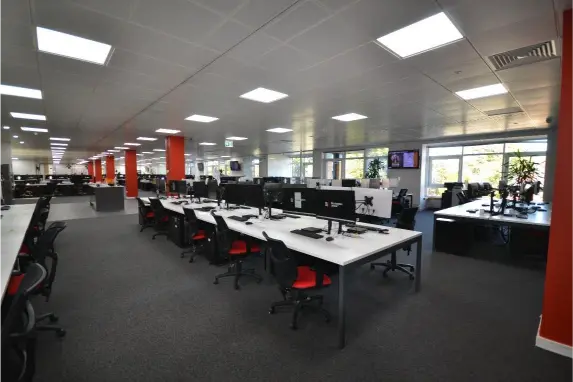
Managing safety, access and communication during refurbishment
Keeping a business open during refurbishment involves more than finding convenient installation times.
When contractors and employees are occupying the same building, the arrangements must also account for safe access, work areas, materials and activities that could affect people nearby.
Keeping occupied areas separate from construction work
Depending on the work, appropriate barriers, controlled access and clearly identified working zones may be required.
Routes used by contractors to move materials should be considered alongside the routes employees and visitors need to use.
Dust and noise also deserve particular attention. The Health and Safety Executive’s guidance on construction dust explains the importance of controlling exposure, rather than treating dust as nothing more than an inconvenience.
Work involving building services may require temporary isolation or restricted access, and some activities simply won’t be suitable while employees remain in the affected area.
The Construction (Design and Management) Regulations 2015 also establish responsibilities for commercial clients commissioning construction work. Suitable management arrangements, competent appointments and sufficient time and resources remain important, whether the premises are occupied or empty.
Keeping staff informed throughout the project
Good communication can make a considerable difference to how a refurbishment is experienced by employees.
People need to know which areas will be unavailable, whether facilities are moving and when particularly disruptive activities are expected.
Establishing a main contact within the business can also help contractors obtain decisions without repeatedly interrupting different members of staff.
For larger projects, regular programme updates may be appropriate, particularly when several departments or working areas are affected.
A realistic schedule should also recognise that unforeseen issues sometimes arise during refurbishment. Identifying how changes will be communicated and agreed is more useful than assuming nothing will ever need adjusting.
Hidden Hearing: An office refurbishment planned around staff
A particularly good example of working around an occupied workplace is our refurbishment project for Hidden Hearing in Kent.
The project involved updating the third and fourth floors of the building, with improvements to both the working environment and shared staff facilities.
The work included replacing ceiling tiles, updating flooring, installing energy-efficient LED lighting, and redecorating and refurbishing toilet facilities. New blinds were fitted to allow more natural light into the offices, while the existing kitchen was transformed into a café area.
Office furniture was also replaced, with Aerofoil Design responsible for that element of the project.
However, the brief involved considerably more than refreshing the appearance of the building.
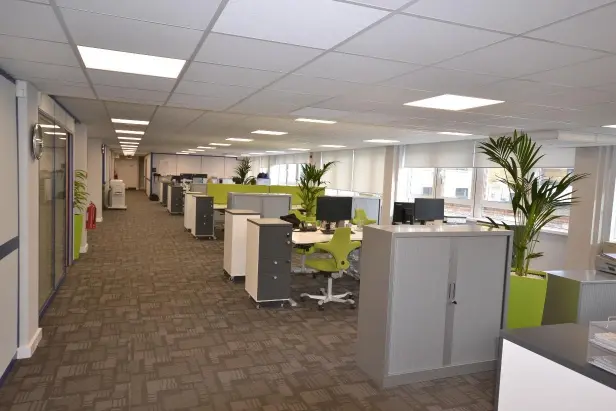
Hidden Hearing needed to continue operating, and a complete shutdown would have been costly. We therefore worked closely with the company to develop a programme that took its employees’ working hours into account.
One practical example involved the installation of new suspended acoustic ceiling tiles. Rather than carrying out this work while employees were using the affected office areas, it was scheduled for times when staff were working off-site or taking breaks.
This helped minimise interference with everyday operations while allowing the improvements to progress.
The wider project demonstrates why the way work is organised can be just as important as the materials being installed. Understanding when spaces are occupied, consulting with the client and coordinating the installation programme all contributed to achieving the brief.
Hidden Hearing subsequently appointed our team for further work at other sites.
You can explore the completed improvements in our Hidden Hearing office refurbishment case study, including photographs of the office spaces and refurbished facilities.
Of course, the same programme wouldn’t necessarily suit every workplace. The important lesson is that the schedule should respond to the needs of the business rather than expecting every business to accommodate an identical installation process.
Plan your office refurbishments with SSC Interiors
An office refurbishment shouldn’t have to remain on your to-do list simply because finding a suitable time feels impossible.
At SSC Interiors, we work with businesses across Sussex, Surrey and the surrounding areas to plan and deliver commercial interior improvements. From partitioning and suspended ceilings to more comprehensive refurbishment projects, we consider how the space needs to function throughout the work as well as afterwards.
If you’re considering updating an office that needs to remain operational, we’d be happy to discuss your premises, working arrangements and proposed improvements.
Call our team on 01444 220525 or contact SSC Interiors to arrange an initial discussion about your project.

Frequently asked questions about office refurbishments
Can you refurbish an office without moving employees out?
Yes, depending on the layout and scope of the work. Some refurbishments can be completed in stages, allowing employees to continue working in unaffected areas. More disruptive activities may require temporary relocation, alternative working arrangements or restricted access. An initial site survey can help establish which options are practical and safe.
How long does an office refurbishment take?
The duration depends on the size of the premises, the work involved and any restrictions associated with an occupied building. Phased installation or work outside standard hours may affect the overall programme. A reliable timescale should be based on the specific project rather than a standard estimate applied to every office.
Is phased office refurbishment more expensive?
It can be, particularly where additional site arrangements, repeated access requirements or out-of-hours working increase labour and management costs. However, these costs need to be considered alongside the potential disruption associated with temporarily closing the business. Comparing different delivery options during planning can help establish a suitable approach.
Can office refurbishment work take place at weekends?
Yes, weekend or evening work may be possible where suitable arrangements can be agreed. Contractor availability, building access, noise restrictions and the nature of the work will influence whether this is practical. It is worth discussing your preferred working hours early, so any additional requirements can be considered when preparing the quotation.
How can noise and dust be controlled during office refurbishment?
Noise and dust need to be assessed and controlled according to the activities taking place. Appropriate measures may include separating work areas, selecting suitable equipment, controlling dust at its source and arranging noisy tasks when fewer people are nearby. Some work may still require employees to leave the affected area temporarily.
Will we still be able to use our kitchen and toilets during refurbishment?
That depends on which facilities are being updated and whether suitable alternatives are available. If a refurbishment involves toilets, kitchens or essential services, access requirements should be considered before work begins. Temporary facilities or a carefully planned sequence may be necessary to ensure appropriate welfare arrangements remain available.
What should we prepare before requesting an office refurbishment quote?
It helps to identify which areas need updating, the changes you want to make and any operational restrictions. Staff numbers, working hours, busy periods and facilities that cannot be taken out of use are particularly useful details. Sharing these requirements early allows the proposed work and programme to reflect how your business operates.
Do we need to close the whole office for electrical or lighting work?
Not necessarily, although some electrical activities require isolation of affected systems or areas. Whether other parts of the office can remain operational depends on the installation, the building’s electrical arrangements and the work being carried out. The requirements should be assessed and appropriate safety arrangements agreed before installation.